As the Bloctel service was about to close its doors permanently, a major incident has marred its exit. A database containing no less than 3 million phone numbers registered on the do-not-call list was hacked and posted on a cybercriminal forum, exposing millions of people to the risk of unwanted solicitation.
Imagine: you signed up for Bloctel to no longer be bothered by unwanted calls. Just days before its closure, the service, which was supposed to protect your peace, sees its database hacked, endangering the information you entrusted to protect yourself. This is what happened with Bloctel, a public service that was supposed to bow out quietly but ended up making headlines.
The essentials to remember
- Bloctel, the do-not-call list, was hacked just before its closure, exposing 3 million phone numbers.
- The hack resulted from the impersonation of a professional account not secured by two-factor authentication.
- The disclosed data can be used for solicitation campaigns, smishing, or phishing.
Bloctel hacking: details of the incident
The Bloctel service, which was designed to protect consumers from unwanted calls, suffered a large-scale hack just before its official closure on August 11, 2026. The attack led to the disclosure of millions of phone numbers on a forum dedicated to cybercriminals.
The information was made public by French Breaches, a reference site for data leaks in France. It appears that the attack was facilitated by the compromise of a professional user account that was not protected by two-factor authentication.
Consequences for users
Although the exposed data is limited to phone numbers and technical identifiers, the consequences for users can be significant. In addition to solicitation calls, victims could be targeted by scams, smishing, and phishing attempts.
These numbers can also be cross-referenced with other data leaks, thus enriching other illicit prospecting databases. This demonstrates the real risks associated with the protection of personal data, even within the framework of public services.
Unanswered questions
Many uncertainties remain, notably the authenticity of the entire leaked database and the exact number of affected numbers. The coincidence between the hacking and the closure of Bloctel also raises questions about a possible link between these two events.
This case highlights a broader issue concerning the security of French public services and their reliance on sometimes insufficient security systems.
Security of professional access in French public services
This Bloctel hack prompts reflection on the security of French public services. Many systems still rely on poorly secured professional access, which can have serious consequences for the protection of personal data. The need to strengthen these accesses, notably through the implementation of two-factor authentication, becomes urgent to prevent future incidents of this type.
The security flaws observed in public services highlight a pressing need for modernization and strengthening of security protocols. In France, authorities like the CNIL are at the forefront to ensure that these improvements are implemented.
Issues of personal data security in France
The Bloctel case is part of a broader context of concerns about personal data security in France. Other incidents, such as those involving online sales platforms or banking services, have already been observed, highlighting the importance of cybersecurity.
With the rise of new technologies, data protection becomes a major issue for businesses and authorities. Actors such as the CNIL, but also companies like Orange or Thales, play a crucial role in developing secure solutions to protect consumers and their personal data.
FAQ
What is Bloctel?
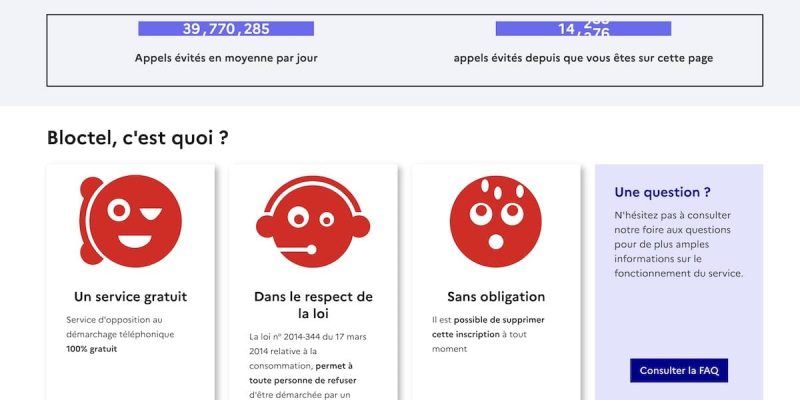
Bloctel was a French public service allowing consumers to register on a do-not-call list to avoid unsolicited telemarketing calls.
How was the Bloctel hack carried out?
The hack was made possible by the impersonation of a professional account lacking two-factor authentication, allowing access to the database of registered numbers.
What are the consequences for the affected individuals?
The affected individuals risk receiving solicitation calls, being targeted by SMS scams (smishing), or phishing attempts.
What measures are being taken to prevent such incidents?
Incidents like Bloctel highlight the need to improve the security of professional access in public services, notably through the adoption of two-factor authentication and other advanced protection measures.