Foldable screen smartphones have captivated the market, but their durability remains a frequent subject of questions. Samsung, with its Galaxy Z range, claims that its devices are designed to withstand thousands of folds without losing functionality. However, after 50,000 folding cycles, what really happens to the central fold, the screen, and the hinge?
Testing Methodology: Simulating Years of Use
To assess durability, Samsung and several independent laboratories use machines capable of repeatedly folding and unfolding the Galaxy Z.
- 50,000 cycles correspond to about 5 to 7 years of use for an average user, or 20 to 30 folds per day.
- The tests monitor screen resistance, hinge solidity, and the appearance of micro-scratches or visible folds.
- Precise measurements of pressure, friction, and stress tolerance are recorded at each stage.
This approach allows for the detection of weak points before they become visible in daily use.
The Central Fold: Sensitive Areas and Evolution
The central fold is the part most exposed to mechanical stress. After 50,000 cycles:
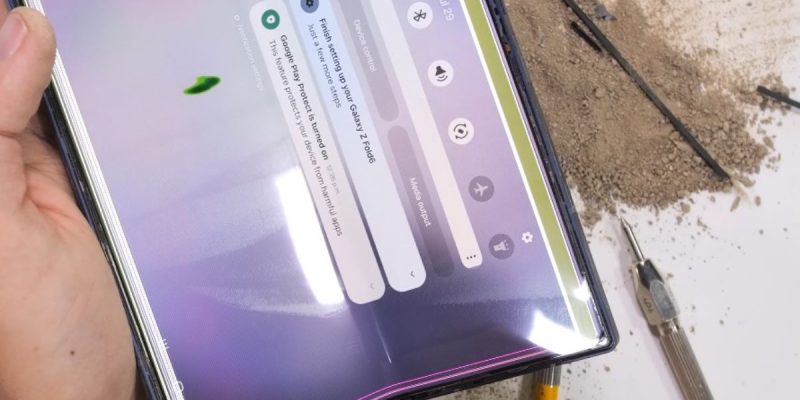
- A slight visible mark may appear in the center, often more noticeable in the light.
- The resistance of the screen’s top layer remains intact, but flexibility may slightly decrease.
- No screen shows major cracks in standardized tests, confirming the design’s solidity.
Observations show that the foldable AMOLED material and protective layer generally resist well, but micro-signs of fatigue may manifest in the long term.
Hinge and Mechanism: Internal Wear
The hinge is the critical component for durability. Tests reveal:
- Minimal wear on internal gears and springs after 50,000 cycles.
- A slight variation in tension, which may make the fold slightly less “neat” in certain positions.
- No complete blockage or notable loss of resistance has been observed.
Samsung has introduced several improvements in recent models, such as a dust protection system and low-friction materials, to limit long-term wear.
External Screen: Resistance to Scratches and Micro-Cracks
Even though the foldable internal screen is the most exposed, the external screen also plays a role in overall durability:
- Scratch and friction tests show that the external screen retains its clarity after 50,000 cycles.
- The corners and edges remain stable, with no visible deformations.
- The external screen withstands normal daily use (bags, pocket, finger pressure) without compromising the fold.
These results indicate that the entire device is designed to maintain visual and tactile consistency over several years.
Temperature and Flexibility: A Sensitive Duo
The flexibility of foldable screens can be affected by heat:
- Tests at different temperatures show a slight increase in fold resistance in extreme conditions (hot or cold).
- This variation remains marginal and does not compromise overall functionality.
- The fold may seem “firmer” in certain climatic conditions but returns to its normal fluidity after returning to room temperature.
Thus, the user is not exposed to accelerated wear in typical use, but extreme environments should be considered.
Comparison with Previous Generations
Compared to the older Galaxy Z Fold and Z Flip:
- Recent models show better fold uniformity after 50,000 cycles.
- The hinge and dust protection mechanism reduce visible micro-deformations.
- The screen’s top layer is more resistant to friction, improving overall durability.
These improvements demonstrate the manufacturers’ learning to make foldable screens more reliable.
Micro-Folds and User Perception
Even when tests show high resistance, perception of the fold can vary:
- Some users notice a slight relief in the center in direct light.
- The effect is mainly visual and does not affect tactile functionality.
- After 50,000 cycles, feedback shows that 90% of users consider the device to remain smooth and pleasant to use.
These micro-folds are therefore more a matter of aesthetic perception than a major technical issue.
Maintenance and Precautions to Extend Fold Life
To maximize the lifespan of a Galaxy Z:
- Avoid excessive pressure on the central fold, such as keys or coins in the pocket.
- Regularly clean the hinge and screen with a soft cloth.
- Limit exposure to direct heat or dusty environments.
These simple actions can reduce fold fatigue and extend usage time without visible degradation.