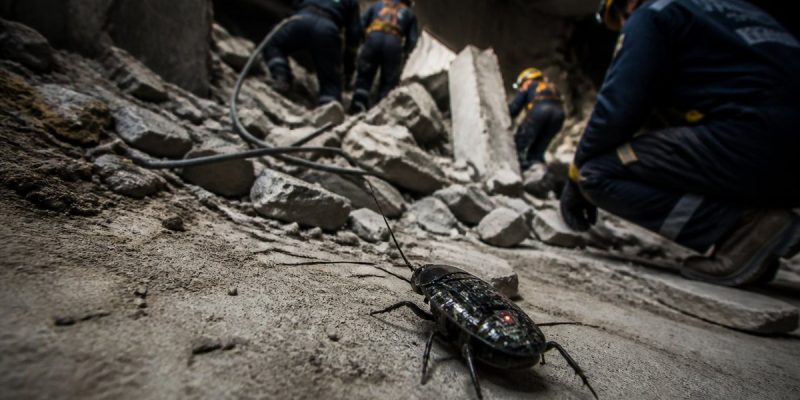
Imagine for a moment, trapped under the rubble of a collapsed building. The chances of being rescued seem slim until a small insect, equipped with cutting-edge technology, sneaks towards you, ready to transmit your location and even administer emergency care. This science fiction-like scenario is now a reality thanks to advances in biorobotics.
Australian researchers have recently unveiled an innovation that could transform rescue operations in disaster areas. By combining biology and technology, they have created cyborg cockroaches capable not only of locating survivors but also of providing them with medical care. This emerging technology, developed by the University of Queensland in collaboration with the University of New South Wales, could redefine emergency interventions in the future.
The 3 key facts
- Cyborg cockroaches are equipped with a remote-controlled injection device to administer medication.
- The species used, Macropanesthia rhinoceros, can carry one and a half times its weight while moving normally.
- The trials, although effective in the laboratory, require further testing in real conditions on disaster sites.
Technological advances of cyborg cockroaches
Researchers chose Macropanesthia rhinoceros as the cyborg insect model due to its robustness and ability to carry equipment. Equipped with the device called Paraborg, these cockroaches can administer medication through a sophisticated injection mechanism. This device uses a chemical reaction to activate the syringe, a principle as simple as the baking soda and vinegar volcano we know from childhood.
This project is not the first attempt to use insects for search missions. However, the addition of the ability to provide medical care marks a significant turning point. Cyborg insects, with their lightness and ability to navigate difficult environments, offer considerable potential for rescue operations.
Challenges to overcome before field use
Although promising, the use of cyborg cockroaches in real conditions presents major challenges. Laboratory trials have shown high success rates in a controlled environment, but the reality of a disaster site is much more complex. Obstacles such as unstable terrain, wireless communication, and the unpredictable movements of victims must be overcome to ensure the effectiveness and safety of interventions.
Moreover, ensuring optimal sterility and safety of medical needles is imperative. Researchers hope that with investments and field trials, these obstacles can be overcome in the next five to ten years.
Collaboration between humans and cyborg insects
The success of this project also relies on smooth interaction between human operators and cyborg insects. Researchers have developed a manual control system via a wireless game controller, allowing operators to precisely direct the cockroaches. This human-machine interaction is essential for navigating complex environments and ensuring the success of rescue missions.
The versatility of cyborg insects is also highlighted, with the possibility of deploying different types of insects for specific missions, leveraging their respective natural strengths.
Frequently Asked Questions
How are cyborg cockroaches controlled? Cyborg cockroaches are remotely controlled by a human operator using a wireless game controller. By stimulating the insect’s antennae and cerci, the operator can guide its movement and change its speed.
What are the advantages of cyborg cockroaches compared to traditional robots? Cyborg cockroaches benefit from exceptional mobility in difficult environments and can be equipped with various devices for specific missions, all at a relatively low cost compared to traditional robots.
What are the next steps for the research team? The team hopes to secure funding to conduct field trials and overcome the technical challenges related to the use of cyborg cockroaches in real environments.
What other cyborg insects have been developed by the team? In addition to cockroaches, the research team has developed cyborg beetles capable of climbing vertical walls, demonstrating the diversity of possible applications for cyborg insects.
The prospects of biorobotics in emergency rescue
As cyborg cockroaches continue to be researched and developed, biorobotics in general is set to become a central player in the field of emergency rescue. Intelligent insects, equipped with detection and intervention capabilities, could become valuable allies for rescue teams, thus reducing response time during natural disasters.
This advancement paves the way for exploring new applications for biorobotics, going beyond rescue missions to include environmental monitoring and natural resource management.
Ethical and regulatory challenges of technological integration
With the rise of biorobotics, ethical and regulatory questions emerge regarding the use of these technologies. Researchers, governments, and regulatory bodies must collaborate to develop guidelines ensuring responsible and ethical use of these emerging technologies.
Companies like Boston Dynamics, with their autonomous robots, or DJI, a leader in the drone field, illustrate the need for strict standards to regulate the use of advanced technologies in sensitive environments. Biorobotics, although still in development, will also need to adapt to these requirements to ensure harmonious integration into our society.