After three months of use, Apple’s iPhone Air has proven to be an appealing device due to its lightness and sleek design. However, it raises questions about its overall performance. So, is this iPhone Air really up to expectations? Here is a user experience that sheds light on its strengths and weaknesses, to help you make the most informed choice possible.
The 3 key points not to miss
- The iPhone Air impresses with its thinness and lightness, but has limitations in terms of battery life.
- It is equipped with an A19 Pro chip, ensuring smooth performance, but its 6.5-inch screen may not suit all users.
- The absence of certain advanced photographic features, such as a x40 zoom, and an audio quality deemed average, may be drawbacks for some.
An appealing design but compromises to be expected
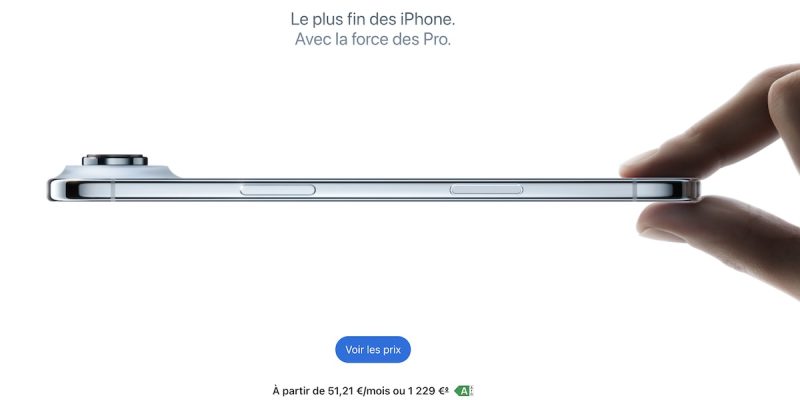
The main asset of the iPhone Air undoubtedly lies in its design. With elegant lines and beveled edges reminiscent of the iPhone 14 and 15 models, this smartphone stands out for its lightness. Many are surprised by its thinness when they hold it.
However, this refined aesthetic is not without concessions. The camera sensor, although efficient, slightly protrudes from its module, a detail that users of 2025 are well aware of. This feature is now common among many manufacturers.
Performance and display: the size compromise
Equipped with the A19 Pro chip, the iPhone Air offers flawless performance. Users can enjoy smooth navigation thanks to iOS 26, without notable slowdowns. The OLED LTPO screen, with an adaptable frequency between 1 and 120 Hz, ensures good display quality.
However, the screen size, limited to 6.5 inches, may not suit those accustomed to larger models, like the iPhone 16 Pro Max. This restricted size offers the advantage of better maneuverability, especially for users with smaller hands.
Disappointing battery life and limited photographic options
The main Achilles’ heel of the iPhone Air is its battery life. With less than 10 hours of screen-on usage, the battery may prove insufficient for those who heavily use their device. Apple’s network chip somewhat helps preserve energy, but it is not enough for a full day of intensive use.
In terms of photography, the absence of certain advanced features, such as an ultra-wide-angle sensor and a x25 or x40 zoom, limits users’ creative possibilities. For those coming from a model like the iPhone 16 Pro Max, this lack can be frustrating.
Audio quality below expectations
The iPhone Air also disappoints with its audio quality. Equipped with a single speaker, the device struggles to offer a fully satisfying sound experience. Although Apple has made notable efforts to improve this aspect, a single speaker does not allow for high-quality sound, especially for a device costing over 1000 euros.
Apple and the evolution of its smartphone models
Since its creation in 1976, Apple has established itself as a major player in the technology field, notably with the introduction of the iPhone in 2007. Each new generation of iPhone has brought its share of innovations and controversies. With the iPhone Air, Apple sought to appeal to users looking for lightness and design, while maintaining efficient performance thanks to cutting-edge components like the A19 Pro chip.
Yet, the ever-increasing competition pushes Apple to constantly reinvent itself. The challenge for the company remains to offer a perfect balance between aesthetics, functionality, and battery life, while meeting the varied expectations of consumers. The iPhone Air is part of this quest, although it does not yet fully satisfy demanding users on all fronts.