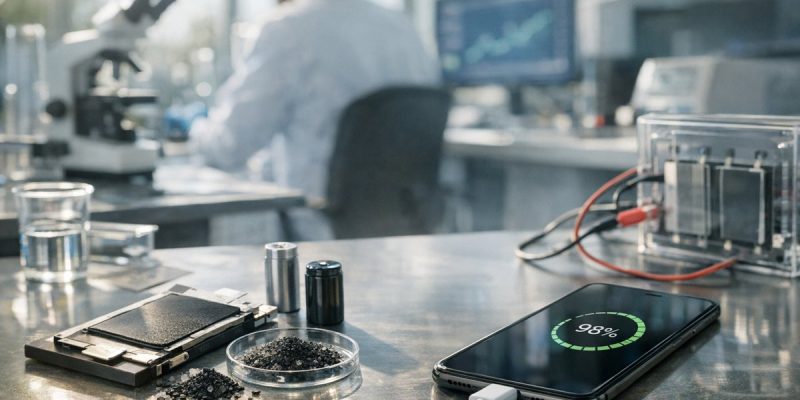
Smartphone users could soon say goodbye to daily charging thanks to a major technological breakthrough. Silicon-carbon batteries, adopted by giants like Honor, RedMagic, and Samsung, promise to significantly increase device autonomy without making them heavier. But what makes this technology so special?
The essentials to remember
- Silicon-carbon batteries increase the energy capacity of smartphones while maintaining their compact size.
- This technology uses a silicon-enriched anode, offering a capacity up to ten times greater than traditional graphite.
- Challenges remain to be overcome, particularly in terms of cost, stability, and battery aging.
Imagine no longer frantically searching for a charger in the middle of the day. You may remember the early days of mobile phones, with their limited autonomy and the need to recharge them every night. Today, thanks to innovations like silicon-carbon batteries, this daily routine could well become a thing of the past. How could this ever-improving technology transform our use of electronic devices?
The advantages of silicon-carbon
Silicon-carbon batteries have remarkable potential. By partially replacing graphite with silicon in the anode, they increase the energy capacity of batteries. Indeed, silicon offers a theoretical capacity that can reach 3,600 mAh/g, compared to only 372 mAh/g for graphite. This substantial gain allows manufacturers to offer smartphones with several days of autonomy, a long-awaited advancement.
This technology has been adopted by several brands, like Honor, which offers a folding smartphone with a capacity of 6,100 mAh, and Redmi, with its Note 17 Pro Max model reaching up to 10,000 mAh. These advancements allow for prolonged use without recharging, although factors like the use of energy-intensive applications can influence actual autonomy.
The challenges to overcome
Despite its advantages, silicon-carbon presents challenges. The main issue is the swelling of silicon when absorbing lithium, which can lead to cracks in the particles and accelerate cell degradation. Manufacturers are striving to solve this problem by combining silicon with a carbon structure, thus limiting undesirable mechanical effects.
Moreover, transitioning to large-scale production requires advanced industrial mastery. Past mistakes, such as those with the Galaxy Note 7, have prompted manufacturers like Samsung to emphasize the stability and safety of their batteries. The cost of production also remains a major obstacle to overcome for this technology to become accessible to all.
Towards wider adoption
In the future, silicon-carbon batteries could revolutionize other sectors, such as laptops, virtual reality headsets, and even electric cars. The increase in energy density would allow for extended autonomy without increasing battery size, a significant advantage for these devices.
However, improvements still need to be made to ensure optimal durability after many charge-discharge cycles. The environmental impact of this technology will also depend on manufacturing processes and battery lifespan, crucial factors to consider in our quest for more sustainable technology.
The issue of cost and industrialization of silicon-carbon batteries
The transition to silicon-carbon batteries faces economic obstacles. The high production cost of these batteries represents a major challenge for their widespread adoption. Manufacturing processes must be optimized to reduce expenses while maintaining consistent quality.
Furthermore, industrializing this technology requires significant investments in research and development to refine processes and ensure large-scale production. Companies like Sila are already working on these aspects, hoping to achieve a 20 to 40% increase in energy density at the cell level, an improvement that could initiate a change in how we use our electronic devices.
Implications for the technology and energy sector
The energy technology sector is evolving rapidly, with increasing pressure for more sustainable and efficient solutions. Companies like Tesla and Panasonic are investing in similar research to improve the performance of their electric vehicle batteries, a booming market.
The implications of these advances in silicon-carbon batteries could influence other sectors, including aerospace and medical devices. Innovations in these areas could transform our consumption habits and energy dependence, a major issue for the coming decades.
FAQ on silicon-carbon batteries
What differentiates silicon-carbon batteries from traditional batteries?
Silicon-carbon batteries use silicon in the anode, which increases energy capacity compared to traditional lithium-ion batteries that primarily use graphite.
What are the main challenges associated with this technology?
The main challenge is the swelling of silicon when absorbing lithium, which can cause cracks and rapid cell degradation. The cost of production also remains a major obstacle.
What are the potential benefits for consumers?
Consumers could benefit from extended autonomy of their devices, reducing the need for frequent recharging. This could transform the user experience, especially for smartphones and laptops.
How could silicon-carbon technology evolve in the future?
With the continuous improvement of manufacturing processes and cost reduction, silicon-carbon technology could expand to other sectors, such as automotive and aerospace, offering more sustainable and efficient energy solutions.